
Garages
Hot tires, oil, antifreeze, winter brine and impact from dropped tools. This is where a flake or full-broadcast system earns its keep, and where adhesion to a properly ground slab matters most.
Industries
Garages, basements, laundry rooms, patios and living spaces across the DMV, matched to the right system and tested for moisture first.
Overview
Most homes in Alexandria, Arlington, Fairfax, DC and Montgomery County have more concrete than the owners think about: the garage slab, the basement, the laundry room, the back patio, the front stoop. It is usually bare, painted, or covered with something that was meant to be temporary. A professionally installed concrete floor can turn that slab into a finished surface without tearing anything out, because the structure you need is already under your feet.
The catch is that a home slab is not a warehouse slab. Many were poured decades ago, often with no vapor barrier beneath them, and they sit in clay soil that holds water through a humid summer and freezes in January. A garage floor sees hot tires and road salt. A basement floor sees moisture coming up from the ground, and a new slab should cure at least 30 days before it is coated or stained. A patio sees sun, rain and freeze-thaw. No single product fits all of that, which is why a good residential job starts with the space, not the product.
This page walks through each space in a typical DMV home, which of our six systems suits it and why, what you should check before anyone mixes a bucket of resin, how an install actually disrupts your week, and where coated concrete is the wrong answer. If you want us to look at a specific slab, request a free estimate and we will measure it, test it and put the scope in writing.
Seven spaces come up again and again. Each has a different enemy, and the enemy decides the system.
Hot tires, oil, antifreeze, winter brine and impact from dropped tools. This is where a flake or full-broadcast system earns its keep, and where adhesion to a properly ground slab matters most.
Moisture, cool temperatures and a floor you want to look finished. Choices range from a breathable polished or sealed slab to a moisture-tolerant primer under a decorative system.
Water from a failed hose or a water heater, detergent spills and a floor that must clean fast. A seamless coating with a drain-aware slope in mind beats grout lines.
UV, rain, freeze-thaw and slip risk. Stained or dyed concrete with a UV-stable sealer, or a textured coating, is the usual path.
Wet feet, chlorine splash, sun and heat. Surface texture and a coating that does not get slick are the first requirements, color comes second.
Kitchens, sunrooms, studios and open-plan ground floors on a slab. Polished concrete or a metallic system turns the slab into the finish floor.
Dropped weights, rolling carts, solvents and wheeled tool chests. Impact and abrasion resistance matter more than looks, though flake delivers both.
Here is how we think about it. For a garage, a flake system is the standard answer: the broadcast hides patches and hairline cracks, adds grip, and the clear topcoat stands up to hot tires. For a basement where you want the plain concrete look and a fast schedule, grind and seal is the practical route. If you want a finished, designed floor, metallic epoxy gives depth and movement, and polished concrete gives a harder, film-free surface that can breathe.
For outdoor slabs and warm color on interior ones, staining and dye systems are the choice. Urethane cement is rarely the first pick for a house, but it is the answer for a commercial-style home kitchen, a wet utility area with temperature swings, or a slab with a long history of moisture trouble where a thicker, more vapor-tolerant system makes sense.
Most residential systems are layered: a primer or base coat bonds and builds thickness, an optional decorative layer such as flake or metallic pigment sits in the middle, and a clear topcoat takes the wear. Standard epoxy makes a strong base but is not UV stable, so in rooms with strong sun, such as a garage with a glass door or a sunroom slab, an exposed epoxy surface tends to amber over time. Installers generally use a polyaspartic or urethane topcoat to protect against that and to resist abrasion and chemicals. Flake also hides slight color shift in the base better than a solid color does.
Polyaspartic cures quickly, which is why one-day installs exist, but it is also less forgiving of heat, humidity and rushed prep, and a fast cure is not a substitute for a tested slab. Slower epoxy systems give more working time and often more build. Neither is automatically better. Ask which products are going on, how many coats, and what the manufacturer's data sheet says about moisture and temperature on install day, and be wary of anyone who compares products only by how many days they take.
Notice what is missing from that list: a universal best. If someone tells you one coating is right for the garage, the basement and the patio, they are selling a product, not designing a floor.
A coating that traps water vapor rising through a slab will eventually bubble, whiten or peel, and the homeowner usually blames the product. Older DMV slabs, especially the older garages and basements in Arlington, Alexandria and close-in Fairfax, were often poured without a vapor barrier underneath. We test before we coat, and the result chooses the system. Some slabs get a moisture-tolerant primer. Some are better left breathable. A few should not be coated at all until the water source outside the house is fixed. The test numbers are not universal: each coating manufacturer publishes its own limit, and a primer built for high-moisture slabs tolerates far more than a standard one. That is why the question to ask is not whether a slab is dry, but whether it is dry enough for the system on the quote.
"Damp basement" also covers three different problems. Liquid water entering after rain is a drainage or waterproofing job that must be solved before any floor goes down. Vapor rising through the slab is what moisture testing measures. Condensation is separate: in a humid DMV summer a cool slab can sit below the dew point of the room air, so water forms on the surface with nothing coming through, and carpet over that slab holds the damp. Coatings only suit the second case, and only after testing.
Less vapor moves up through the concrete, so there is less to push on the coating.
Vapor keeps rising. A sealed, low-permeability coating traps it, and the result can be bubbles, blisters and peeling weeks or months later.
Simplified illustration. A moisture test before coating shows which case a real slab is closer to.
Local housing stock shapes the work. In Arlington, local reporting based on county data puts most single-family homes as built before 1960, which means many slabs predate modern vapor barrier practice. Postwar ramblers, split-levels and colonials in Arlington, Alexandria and Falls Church often have older slabs with an unknown moisture history. Townhouse communities in Kingstowne, Lorton, Burke, Centreville and Bowie have one-car and tandem garages where the slab is newer but the space is tight. DC rowhouse basements, many of them heated and used as living space or rental units, sit below grade in very old masonry foundations, and building-inspection guidance notes that the basement floor and the lower part of the walls are usually the wettest surfaces in the house. Summer humidity can add condensation on top of that.
Then there is the weather. Humid summers push moisture vapor through slabs and complicate curing, so installs are planned around temperature and humidity, not just the calendar. Winters bring brine and road salt that rides in on tires and melts into puddles on the garage floor, and freeze-thaw cycles punish exterior concrete, causing surface scaling on porches, steps and patios. A sealer that is wrong for freeze-thaw will flake off by spring.
One thing we will not do is promise that a coating fixes water problems. If a basement floods or the slab is wet after rain, the answer starts with drainage, gutters, grading or a waterproofing contractor. Radon is a similar case. Fairfax County describes itself as EPA Zone 1 (high potential), the EPA and the Virginia Department of Health call for action at 4 pCi/L or higher, and testing is the only way to know. A coating is not a radon mitigation system, so if you have not tested a basement you plan to finish, test first. A coating can be part of a finished basement once those issues are handled.
Six things decide the plan. A good installer will walk through every one of them with you at the estimate.
The taped plastic sheet left for 24 hours is a rough screen that only tells you whether moisture is obvious. A real test uses in-situ relative humidity probes (ASTM F2170) or a calcium chloride kit (ASTM F1869). Each system has its own limit, so the number matters.
Existing coatings must be ground off or proven well bonded. Epoxy over failing paint will fail with the paint. Grinding also reveals what the slab really looks like.
Hairline cracks and control joints are repaired and treated as part of the scope. A crack that moves is a structural question, not a cosmetic one.
Oil that has soaked into concrete can break down a coating from below. Deep stains need removal or treatment, not a thicker coat.
Soft, dusty or scaling concrete cannot hold a coating. Hardness, flatness and spalling are checked before a system is chosen.
Downspouts, grading, window wells and plumbing leaks. If water is entering the slab from outside, fix that first.
Timing varies by system and weather, so treat these as typical, not promised. Here is the usual sequence for a garage or basement.
Everything off the floor, cars out of the garage, furniture out of the basement. Plan where it lives for a few days.
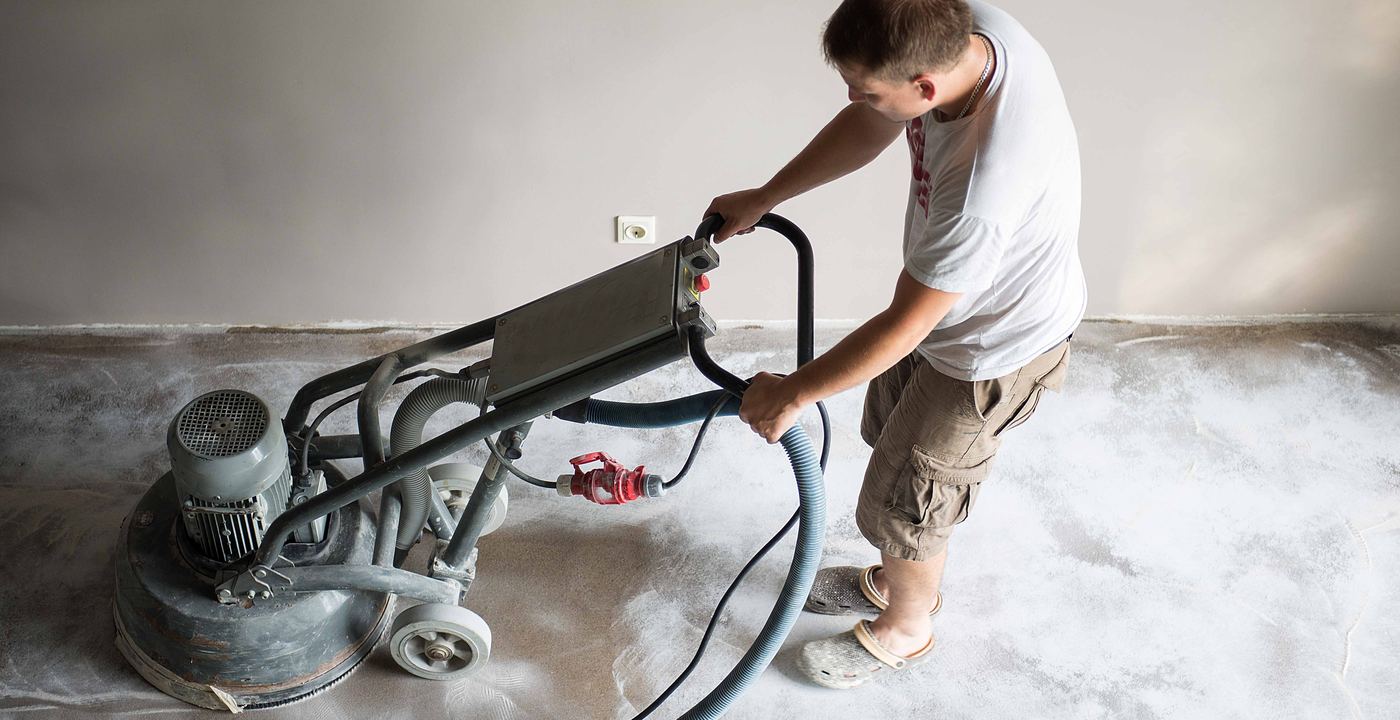
Diamond grinders with dust extraction open the slab and remove old coatings. Expect noise and some vibration, but not the dust cloud you may be picturing.
Cracks, joints and chips are filled and leveled. This is where a bad slab gets honest treatment.
Moisture-tolerant primers or pigmented base coats go down. Odor during this stage is common, so ventilation matters.
Flake is broadcast, metallic pigments are worked in, or the stain is applied, depending on the system.
A clear urethane or polyaspartic topcoat adds abrasion and chemical resistance and sets the sheen.
Light foot traffic often comes within a day. Cars and furniture wait longer, and the cure timeline depends on the system and the temperature.
Honest trade-offs, not a sales chart. Every option wins somewhere.
| Option | Moisture tolerance | Daily cleaning | Comfort underfoot | Where it struggles |
|---|---|---|---|---|
| Coated or polished concrete | Depends on the system; test first | Seamless, easy | Hard and cool | Wet slabs, cracks that keep moving |
| Floor paint | Poor on damp slabs | Fair | Hard | Wears off, hot-tire pickup, peels with moisture |
| Tile | Fair, grout can stain | Grout lines collect dirt | Hard and cold | Cracks over slab movement, heavier prep |
| Luxury vinyl plank | Needs moisture barrier underlay | Easy | Softer | Traps moisture, can swell or mold underneath |
| Carpet | Poor in basements | Hard to clean | Soft and warm | Holds moisture and odor, damaged by leaks |
Area rugs and radiant heat solve the cold-feet complaint on polished and coated floors for most households.
Daily use is where coated concrete pays off. There are no seams for dirt to hide in, spills wipe up, and the surface is not damaged by a flood in the way carpet and some wood-look floors are. A garage floor that looks clean also changes how you use the space: people park cars, set up workbenches and actually use the room.
On resale, we will be careful. A well-done garage or basement floor makes a house show better and reads as a finished space, but we cannot promise a return on the investment and nobody honestly can. What a good floor does do is remove an objection at the inspection stage, because there is no stained or peeling surface to explain.
Know the limits. These floors are hard and cooler than carpet. Gloss can be slick when wet. A film coating is not breathable, so it is the wrong choice for a slab with active water intrusion. And any coating can be scratched by a dragged jack stand.
A coating is the last step on a slab that is ready, not the fix for one that is not.
Most failures are predictable, and almost all trace back to the same few shortcuts.
The most expensive shortcut. A floor can look perfect for a month and then lift where the slab is wet.
Etching leaves an uneven profile and residue. Mechanical diamond grinding gives a consistent surface for the coating to bond to.
Thin, one-part products over unprepared concrete often peel, particularly under hot tires. They also trap moisture.
The new system is only as good as what it sits on.
The sample looks great in the showroom. The question that matters is what the slab, the use and the weather need.
Cure problems such as blush or poor bond are tied to temperature and humidity, so DMV summers need planning.
We do not quote numbers on this page, because they would mean nothing without seeing your slab. Here is what moves the figure on any residential job, in roughly the order that matters.
Square footage sets the baseline, but cut-up spaces such as a finished basement with many small rooms take longer than one open garage. Slab condition drives the repair scope. The system you choose, whether flake, metallic, grind and seal or polished, changes the material and labor. Moisture mitigation adds steps when a test calls for it. Access, such as stairs or a tight townhouse garage, matters, as does how much old coating has to be removed. Extras like slip-resistant additive, custom colors and cove bases also factor in.
Use these questions with us and with everyone else you talk to. The answers tell you more than the brochure.
Questions
For the right spaces, yes. Garages, laundry rooms, workshops and many basements suit it because it is seamless and easy to clean. It is a poor fit for slabs with active moisture problems or for rooms where you want a soft, warm surface. The slab test decides.
It can be slippery when wet unless texture is added, it is hard and cool underfoot, and it can fail if the slab is damp or poorly prepared. Standard epoxy is not UV stable and can amber in direct sun, which is why a polyaspartic or urethane topcoat is commonly used over it where the floor gets light.
Often yes, but it depends on moisture. Many older slabs were poured without a vapor barrier. We test first, then recommend a moisture-tolerant system, a breathable finish such as polished concrete, or a fix to the water source before coating.
It feels cooler than carpet and about the same as tile. Area rugs help, and polished concrete pairs well with radiant heat in a heated rowhouse basement.
Typically one to a few days depending on the system, with foot traffic often within a day and vehicles after a longer cure. Timelines vary with temperature and humidity, so we confirm at the estimate.
A properly bonded system with a urethane or polyaspartic topcoat is designed for both. Bonding depends on diamond grinding and moisture testing, which is where most failures begin.
Yes. Outdoor slabs need UV-stable sealers or textured coatings that handle freeze-thaw, and pool decks need surface texture for wet feet. Staining or dyeing is common outside.
We cannot promise a number. A clean, finished garage or basement floor helps a house show better and removes a visible flaw, which buyers notice.
Often. We grind off the failed coating, treat the slab and start over. If the old coating is sound and well bonded, it can sometimes serve as a base for a new system.
No floor finish stops water. Polished concrete with a breathable finish lets vapor pass instead of trapping it, which suits some slabs, but liquid water or a persistently wet slab needs its source fixed first. A sealed or coated surface is less breathable, so we test and choose accordingly.
Dust mop, then damp mop with a neutral cleaner. Avoid acidic cleaners such as vinegar, which can dull sealers. Wipe road salt and brine off a garage floor in winter, and use mats under jack stands.
Yes. Fairfax County classes itself as EPA Zone 1 for radon potential and the EPA and Virginia Department of Health call for action at 4 pCi/L or higher. A floor coating is not a mitigation system.
Tell us about your space. We'll recommend the right system and send a free estimate.