Epoxy flooring explained: what you are actually buying
The phrase "epoxy floor" gets used for almost any liquid-applied resin finish on concrete, which is why two quotes for the same room can describe completely different floors. Epoxy is one branch of what the trade calls resinous flooring: thermosetting resins that are mixed on site, spread over a prepared slab and cured into a hard, continuous film. The other branches you will hear about are polyurethane, polyaspartic, polyurea, methyl methacrylate and urethane cement. Many real floors combine more than one of them, with epoxy doing the bonding and building and a different resin on top.
Chemically, epoxy is a two-part material. A resin and a hardener react and crosslink into a rigid plastic that grips ground concrete tenaciously, builds thickness in a single pass and shrugs off oil, brine and most household and shop chemicals. Those strengths make it the default base layer for garages, basements, workshops, warehouses and back-of-house commercial floors. Its weaknesses are just as specific: it ambers in sunlight, it does not like heat shock, it is rigid, and it cannot hold back water vapor pushing up through a slab. Choosing well means pairing each weakness with the right companion product or picking another floor.
DST installs three epoxy-based looks: solid color, decorative flake broadcast and hand-worked metallic. This page is the hub for all three. It covers the formulations, the thickness classes, where each system belongs, the honest limits, basements in older DMV homes, timelines, upkeep and cost drivers. When one system clearly fits your space, the page sends you down to the detailed guide: garage floor epoxy for garages and shops, metallic epoxy for showpiece rooms, and urethane cement when epoxy is the wrong tool.
Epoxy, polyurethane, polyaspartic, polyurea: who does what
These resins are cousins, and contractors mix them in one floor on purpose. The table shows how each one tends to behave; the product data sheet decides the specifics.
Resin
Role it plays best
Strengths
Watch-outs
Epoxy
Primer, body coat, build coat
Strong bond to ground concrete, thick film per coat, chemical and oil resistance, long working time
Aromatic chemistry ambers under UV, rigid, slower cure, softens under hot water
Polyurethane
Thin clear or pigmented topcoat
Scratch and abrasion resistance, satin or gloss, color-stable aliphatic grades
Thin per coat, so it protects rather than builds; moisture sensitive while curing
Polyaspartic
Fast topcoat, sometimes a full system
Aliphatic polyurea chemistry that stays clear in sun, cures in hours, wide temperature window
Short pot life, less forgiving to apply, usually more coats to reach the same build
Polyurea (fast-set)
Joint fillers, flexible membranes, fast single-visit systems
Elongation, very fast set, bridges small movement
Spray or fast-mix application needs trained crews; some grades are aromatic and discolor
Urethane cement
Kitchens, breweries, wash-down floors
Tolerates thermal shock and moisture, expands close to concrete
Utilitarian look, heavier material, trowel or slurry applied; see urethane cement
A typical premium residential floor today is an epoxy primer and body coat with a polyaspartic or polyurethane clear. Calling the whole thing "epoxy" is shorthand, not a lie, but ask what the top layer is.
100% solids, water-based and solvent-based epoxy
The second thing to pin down is the formulation. "Solids" means the share of the wet material that remains after cure. Water-based and solvent-based epoxies use a carrier that evaporates, and Sherwin-Williams' resinous flooring technical notes say that evaporation can cost as much as half of the wet film: a 7-mil wet coat can dry to roughly 3 to 3.5 mils. A 100% solids epoxy has no carrier, so what goes down is what stays, commonly 10 mils or more in one coat.
That difference drives everything downstream. Thin water-based films are easy to roll, low in odor, and in some products can go onto damp or still-curing concrete, but they wear through sooner and are better treated as sealers or light-duty finishes. Solvent-borne epoxies once ruled garages and parking decks because they tolerated oil-contaminated slabs and dried glossy; tighter VOC rules have pushed them to the margins. The 100% solids type is the professional standard for floors expected to carry traffic for years. Its tradeoff is a short pot life, in the range of half an hour, which is a crew skill, not a homeowner project.
Hardware-store kits are usually water-based or low-solids products. That is the real reason a kit floor and a contractor floor look alike on day one and nothing alike in year three. If a quote does not say what percentage solids the body coat is, ask.
Wet film vs dry film: why carrier matters
Water- or solvent-based epoxy, as applied7 mils wet
Carrier evaporates as it dries
Same coat, driedabout 3 to 3.5 mils
Roughly half the film is gone
100% solids epoxy, applied and dried10 mils or more
No carrier: what goes down stays
From the Sherwin-Williams resinous flooring technical notes cited on this page. Product-specific; the data sheet governs.
The three system types DST installs
All three sit on the same ground and tested slab. They differ in what goes into the body coat and what the finish looks like.
Solid color epoxy
A pigmented body coat in one uniform tone, usually under a clear or matching topcoat. It is the simplest look, the easiest to touch up and the standard for warehouses, mechanical rooms, laundries and utility basements. Light grays brighten a windowless space; it shows dust and scratches more than textured finishes.
Flake broadcast
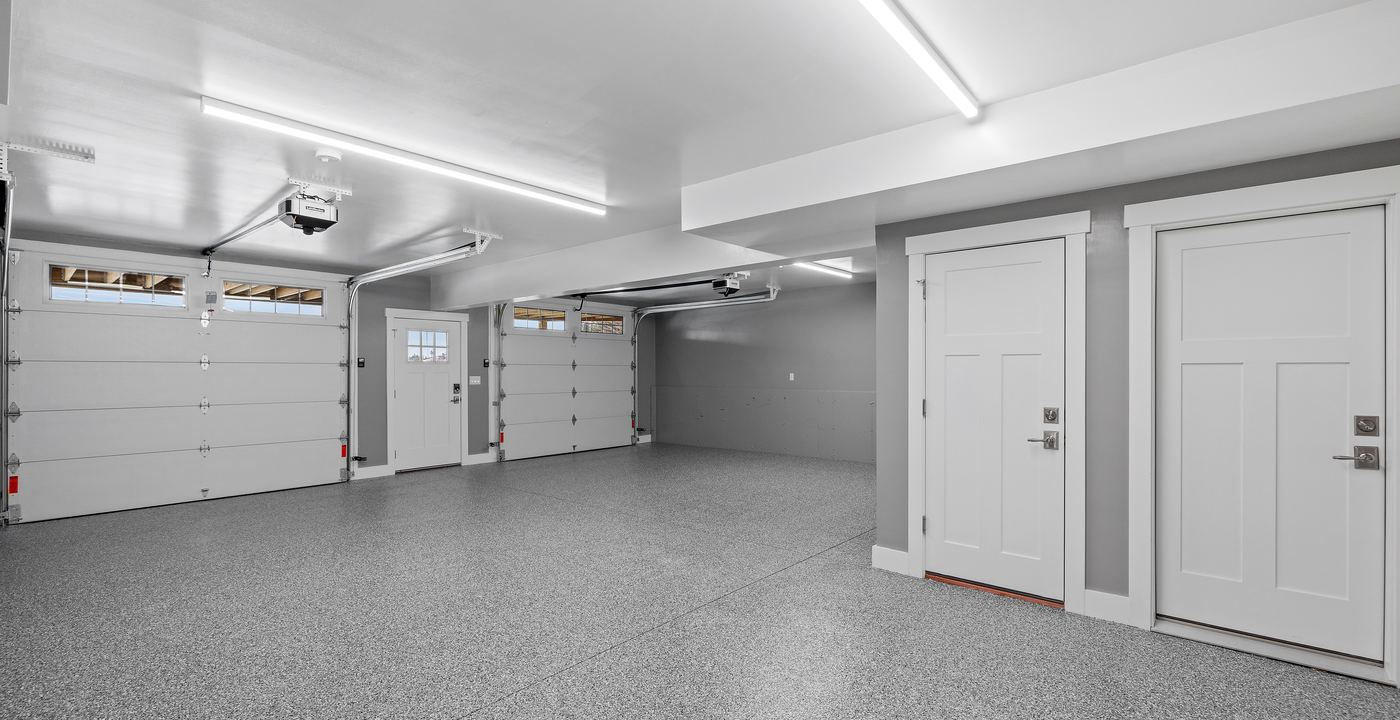
Vinyl chips thrown into the wet body coat and sealed under clear. The texture hides slab blemishes and adds grip, which is why it dominates garages, shops and mudrooms. Chip sizes, blends, coverage and the whole garage conversation live on the garage floor epoxy page.
Metallic epoxy
Reflective pigments suspended in a thick clear body coat and moved by hand while wet. It reads as stone or flowing water and suits finished basements, salons and showrooms. Pigment behavior, color planning and topcoat choices are covered on the metallic epoxy page.
Quartz broadcast (for reference)
Colored quartz sand broadcast into resin, giving a dense, textured, very hard-wearing surface used in commercial restrooms, locker rooms and kitchens. It exists in the market and is worth knowing about; it is not one of DST's listed systems.
Topcoat choices across all three
Epoxy clear for depth and chemical resistance indoors, polyurethane for scratch resistance and satin options, polyaspartic where sun, speed or temperature swings matter. Anti-slip grit can be added to any of them.
Accessories that change the result
Integral cove base at walls, color-banded zones, logos, and moisture mitigation primers under any of the three. These belong in the written scope, not the sales conversation.
The same prepared slab can carry a solid color, a flake broadcast or a metallic finish.
Thickness classes and what each one is for
Thickness is measured in mils (one mil is a thousandth of an inch). SSPC Guide 20 draws its line at 20 mils: thin-film below, thick-film above, with self-leveling, slurry, broadcast and mortar systems in the thick-film group. Numbers below are general; data sheets govern.
Garages, workshops, retail, most residential systems
Broadcast system
20 to 60-plus mils with chips or quartz
Body coat, broadcast to refusal, scrape, clear coats
Garages, shops, restrooms, wet areas needing grip
Self-leveling
About 1/16 to 1/8 inch
Poured and gauge-raked, flows out flat
Uneven slabs, showrooms, metallic body coats, manufacturing floors
Mortar or slurry
1/8 to 1/4 inch and up
Troweled or screeded with aggregate
Heavy impact, forklift lanes, kitchens (urethane cement), spall-prone slabs
More thickness is not automatically better. A 100-mil mortar in a finished basement is wasted money; a 6-mil film under forklifts is wasted time. Match the class to the load and the slab.
Thickness classes side by side (mils)
02060125250
Thin-film coating
6 to under 20 mils
High-build coating
20 to about 40 mils
Broadcast system
20 to 60-plus mils
Self-leveling
about 1/16 to 1/8 inch
Mortar or slurry
1/8 to 1/4 inch and up
Rough dry builds from the table above. 1/16 inch is about 62 mils; 1/4 inch is about 250. SSPC Guide 20 draws the thin-film line at 20 mils.
Decision table: which system for which room
Use this as a starting point, then follow the link for the detailed page. The right answer can change once the slab is tested.
Space
Usual recommendation
Why
Detailed guide
Residential garage, townhouse garage
Flake broadcast with polyaspartic or urethane clear
Hides stains, adds grip, handles brine and tires, UV-stable at the door
If a contractor recommends the same system for every row of this table, that tells you what they stock, not what you need.
What epoxy cannot do
Every good epoxy floor is a workaround for one of these four limits. Knowing them tells you what to specify.
Stay clear in sunlight
Standard epoxy resins are aromatic. Ultraviolet light photo-oxidizes them, and the film turns amber, then chalky. Indoors away from glass it is a non-issue. Near a south-facing garage door, a walk-out basement slider or a storefront window, the fix is an aliphatic polyaspartic or polyurethane topcoat over the epoxy. No topcoat makes epoxy exterior-grade.
Hold back moisture vapor
A cured epoxy film is nearly impermeable, which is exactly why vapor driving up from damp soil lifts it in blisters. Epoxy does not waterproof a slab from below. Elevated readings call for a two-component mitigation membrane in the ASTM F3010 category, applied within the manufacturer's rated limits. Readings beyond those limits call for a breathable floor instead.
Take thermal shock
Epoxy and concrete expand at different rates. Pour hot water on a cold epoxy floor, or run a steam cleaner over it, and the mismatch shears the bond. Trade sources on food-plant flooring put epoxy's softening point for hot washdown around 50 C (122 F). That is the whole reason urethane cement exists.
Flex over moving cracks
Epoxy is a rigid plastic. It will bridge a dormant hairline crack after proper fill, but a crack that opens and closes with the seasons, or a control joint doing its job, will telegraph straight through. Those get a flexible or semi-rigid polyurea or polyurethane sealant, or are left as honest, clean lines.
Fix a bad slab
Soft, dusting, scaling or contaminated concrete fails under any coating. Oil-soaked mid-century garage slabs and chalky basement floors sometimes need repair, degreasing passes or a mortar overlay before a finish is even discussed.
Cure on your schedule
Epoxy cures by chemistry, and chemistry slows in the cold. Below the data sheet's minimum slab temperature it stays soft and can blush. Unheated basements in January and open garages in a cold snap need heat, a different resin or a different week.
Basements in older DMV homes: a different conversation from the garage
Garage coatings fail loudly and get blamed on tires. Basement coatings fail quietly, under carpet tiles and workout mats, in rooms people live in. The brick rowhouses of Capitol Hill and Petworth, the 1940s and 50s colonials in Del Ray, Arlington and Silver Spring, and the split-levels of Annandale and Wheaton sit on slabs that often went in before a continuous plastic vapor retarder was standard practice. Building science writers note that a retarder cannot be added later without removing the slab. So the slab is what it is, and the coating has to be chosen to suit it.
In a finished basement the stakes go beyond the floor. Summer dew points in this region push humid outdoor air into cool below-grade rooms, where it condenses on the coldest surfaces. The EPA's mold guidance names a dehumidifier as a basic tool for a humid basement and reminds homeowners to grade soil away from the foundation. A sealed epoxy floor removes one path for ground moisture to evaporate into the room, which can help humidity, but it also means any vapor arriving under the film has nowhere to go. That is why a basement gets in-slab relative humidity probes before anyone picks a color, and why a mitigation membrane rated for the reading goes down when the numbers say so.
Living space also raises odor and ventilation. A 100% solids epoxy has little solvent to off-gas, but the amine hardener gives a sharp smell while it cures, and solvent-thinned products or cheap kits can linger for weeks; the lingering-odor threads on homeowner forums almost always trace back to that. For an occupied home the plan should name low-odor products, say how the space will be ventilated during cure, and give a return date for bedrooms above. Finished basements with a bar, a theater zone or a home gym also deserve a satin clear to tame glare under can lights, and rugs or mats chosen so they do not trap moisture against the film.
Prep and moisture testing in brief
The garage guide walks through grinding profiles, crack chasing and the moisture test methods in full. Here is the short version that applies to every epoxy system DST installs.
Read the slab first
Age, cracks, joints, prior coatings, oil staining and any sign of efflorescence or dampness are logged before a system is proposed.
Measure moisture, do not guess
In-slab relative humidity (ASTM F2170) and surface vapor emission (ASTM F1869) are the recognized methods, and the coating manufacturer sets the pass line. The result picks the primer.
Diamond grind, never acid etch
Grinding removes laitance and contamination and opens a profile on the ICRI CSP scale that matches the data sheet. Thicker systems want a coarser profile than thin films.
Repair, then coat
Cracks are chased and filled, spalls patched, joints treated with the right rigidity for whether they move. Repairs are listed in the written scope so you can compare quotes line by line.
Prime to the condition
Penetrating epoxy primer on a dry slab; an F3010-type mitigation membrane on an elevated one. Skipping this layer to save a day is the most expensive shortcut in the trade.
Build and finish within the windows
Each coat goes on inside its recoat window and above the minimum slab temperature. Missed windows mean sanding; cold slabs mean waiting.
Timelines, cure and when you get the room back
Resinous floors are built in layers with cure time between them, so the calendar depends on how many layers you chose and how fast each one sets. A thin-film solid color basement can be a two-day job. A high-build garage with a polyaspartic clear is commonly one or two days on site. A metallic floor or a self-leveling commercial system runs several days because thick coats need overnight cures. Mortar systems and large warehouses are scheduled in phases.
Cure has stages. Tack-free comes first, then foot traffic, then furniture and light vehicles, then full chemical and hot-tire exposure. Fast polyaspartic clears compress those stages into hours and a couple of days; epoxy clears stretch them across most of a week. Temperature matters more than the brand: a 55-degree basement cures far slower than a 75-degree one, and humidity above the data sheet limit can cloud or blush an epoxy surface.
None of these ranges are DST commitments. They are how the materials behave. Your written estimate should carry the specific windows for the products going on your slab, and those come from the data sheets and the forecast, not from a sales script.
Ask for the day-by-day sequence and which coats cure overnight
Ask what the floor can take at 24 hours, 72 hours and one week
Plan heat or dehumidification if the room is cold or damp during install
Keep rugs, mats and heavy furniture off until the full-cure date, not the walk-on date
How cure stages stack up: fast clear vs epoxy clear
Hours
Day 1-2
Day 3-4
About a week
Polyaspartic clear
Tack-free, foot trafficFurniture, light vehicles, then full use
Epoxy clear
Tack-freeFoot trafficFurniture, light vehiclesFull chemical and hot-tire use
General pattern from the timeline section, not a schedule for any job. Temperature and humidity move every stage.
Maintenance, recoats and repairs
A cured epoxy system asks little. Grit is the enemy, because sand and road debris act like sandpaper under foot and tire. Sweep or vacuum, then mop with water and a neutral-pH cleaner. Avoid acidic descalers, citrus strippers and abrasive pads, which dull the clear. Rinse winter brine toward the drain before it dries in rings. Felt under furniture, soft casters under tool chests, and a mat under a car that drips.
Scratches and dull lanes live in the topcoat, and that is by design. When traffic paths lose their sheen after some years, the floor is lightly abraded and a fresh clear is applied, which restores the look and resets the wear layer without touching the color coat beneath. That is the single best reason to insist on a quality, recoatable clear at the start.
Real damage is handled by type. A gouge from a dropped tool is filled and spot-coated; on a flake floor the chips make the patch disappear, on a solid color it will show slightly until the next clear coat, on a metallic the section is usually re-worked rather than dabbed. A blister or lifting patch is different: it is a moisture or bond symptom, and the honest repair starts with finding out why, not with a bigger dab of resin.
What affects the cost, and what to ask before you sign
Resinous floors are quoted per project because the slab and the system vary more than the square footage does. Two 600-square-foot basements can differ by a factor of several if one needs mitigation, repair and a metallic finish and the other needs a thin-film solid color on sound, dry concrete. The levers below are roughly in order of how much they move a quote. DST measures and tests on site and the estimate is free.
The questions in the side box work for a garage, a basement or a 40,000-square-foot warehouse. Specific, written answers are the point; vague ones are the warning. Red flags are easy to spot once you know them: the same system quoted for every room, "forever" or "moisture-proof" language with no test behind it, acid etching described as prep, and no data sheets or layer list. You can send photos and measurements for a no-cost assessment and compare what you hear.
System type and thickness class: thin-film, high-build, broadcast, self-leveling or mortar
Moisture results and whether an F3010-type membrane is required
Slab repair: crack count, spalls, old coatings or adhesive to grind off, oil contamination
Formulation: 100% solids body coats cost more than water-based films and last longer
Topcoat chemistry and number of clear coats, plus anti-slip aggregate
Edges and details: cove base, stairs, columns, drains, cabinets that stay in place
Access and logistics: tight townhouse garages, elevator-only buildings, after-hours commercial work
Season and conditions: heat, dehumidification or tenting to stay inside product windows
Questions
Epoxy flooring questions people ask
Is epoxy flooring worth it?
For garages, basements, shops and commercial floors on sound, tested concrete, usually yes: a professionally installed 100% solids system with a quality topcoat turns a dusting, staining slab into a sealed surface that cleans with a mop and can be refreshed with a clear recoat instead of replaced. It is not worth it on a slab with unresolved water intrusion, in direct sun without an aliphatic topcoat, or in a hot wash-down kitchen where urethane cement is the correct product.
How thick should epoxy flooring be?
It depends on the class. Thin-film coatings run under 20 mils total and suit light-duty basements and storage. High-build and broadcast systems for garages and shops land above 20 mils, with 100% solids body coats delivering 10 mils or more per pass. Self-leveling floors are poured at roughly 1/16 to 1/8 inch, and mortars thicker still for forklifts and impact. Match the class to the load; ask the contractor for the target dry build in writing.
How long does epoxy flooring last?
It is decided by five things: how the slab was ground, whether moisture was measured and addressed, the percentage solids and thickness of the body coat, the chemistry of the topcoat, and how much grit, sun and traffic the floor sees. One published flooring guide, Flooring Clarity, places residential epoxy in the 10 to 20 year range and commercial floors shorter, with preparation cited as the biggest factor. Treat that as a reference point, not a promise. A recoatable clear lets the wear layer be renewed long before the color coat is gone.
What is the best type of coating for a garage floor?
For most DMV garages, a ground and moisture-tested slab, an epoxy or moisture-tolerant primer and body coat, a full flake broadcast and a UV-stable polyaspartic or polyurethane clear. The flake gives texture and hides stains, and the aliphatic clear stays clear at a sunny door and resists tires. The full reasoning, including one-day versus two-day installs, is on the garage floor epoxy page.
Can you put epoxy on a basement floor?
Yes, and basements are one of the best uses, provided the slab is tested first. Older homes across DC, Arlington, Alexandria and Montgomery County often lack a vapor retarder under the slab, so in-slab relative humidity is measured and a mitigation membrane is used when readings call for it. For a finished basement, also plan for low-odor products, ventilation during cure and a satin finish under recessed lighting.
What is the downside of epoxy flooring?
Four real ones: it ambers in sunlight unless topped with an aliphatic clear, it cannot stop vapor pushing up through a damp slab, it is rigid and will crack over joints and cracks that move, and it dislikes thermal shock from hot water. Add a smooth surface that is slick when wet unless grit is added, and visible scratching on dark, glossy solid colors. Each has a known remedy or a better-suited alternative floor.
What is the difference between epoxy and polyaspartic?
Epoxy is a two-part resin that bonds hard and builds thick but ambers in UV and cures slowly. Polyaspartic is an aliphatic polyurea: it stays clear in sun, cures in hours and tolerates a wider temperature range, but has a short working time and is thinner per coat. Many floors use epoxy as the base and polyaspartic as the finish to get both sets of strengths.
Is polyurea better than epoxy?
They do different jobs. Fast-set polyurea flexes and sets quickly, which suits joint fillers and single-visit systems; epoxy bonds and builds better as a body coat. "Twenty times stronger" claims compare one property in a lab, not a floor in a garage. Ask what each layer of the proposed floor is and judge the whole system.
What is the difference between resinous flooring and epoxy flooring?
Resinous flooring is the family; epoxy is one member. The family also includes polyurethane, polyaspartic, polyurea, methyl methacrylate and urethane cement. Most installed floors are hybrids that use two or three of these in different layers.
Is epoxy flooring slippery?
A smooth, glossy solid color can be slick when wet. Flake and quartz broadcasts add texture, and a fine aluminum oxide or polymer grit can be mixed into any topcoat. For commercial spaces, wet slip resistance is commonly specified under ANSI A326.3 DCOF testing, so ask for the texture you want on a sample board and, where it matters, a measured value.
Does epoxy flooring smell, and how long?
The sharp smell during install comes mostly from the amine hardener and clears with moving air as the floor cures, usually within a day or two for 100% solids products. Solvent-thinned epoxies and low-cost kits can linger much longer. In an occupied home, ask for low-odor products, a ventilation plan and a written return-to-occupancy date.
Can epoxy go over old epoxy or a failed kit floor?
Only after the old layer is tested or removed. A sound, well-bonded coating can sometimes be abraded and recoated; a peeling, chalky or kit-applied layer is ground off to bare concrete so the new system bonds to the slab, not to the failure.