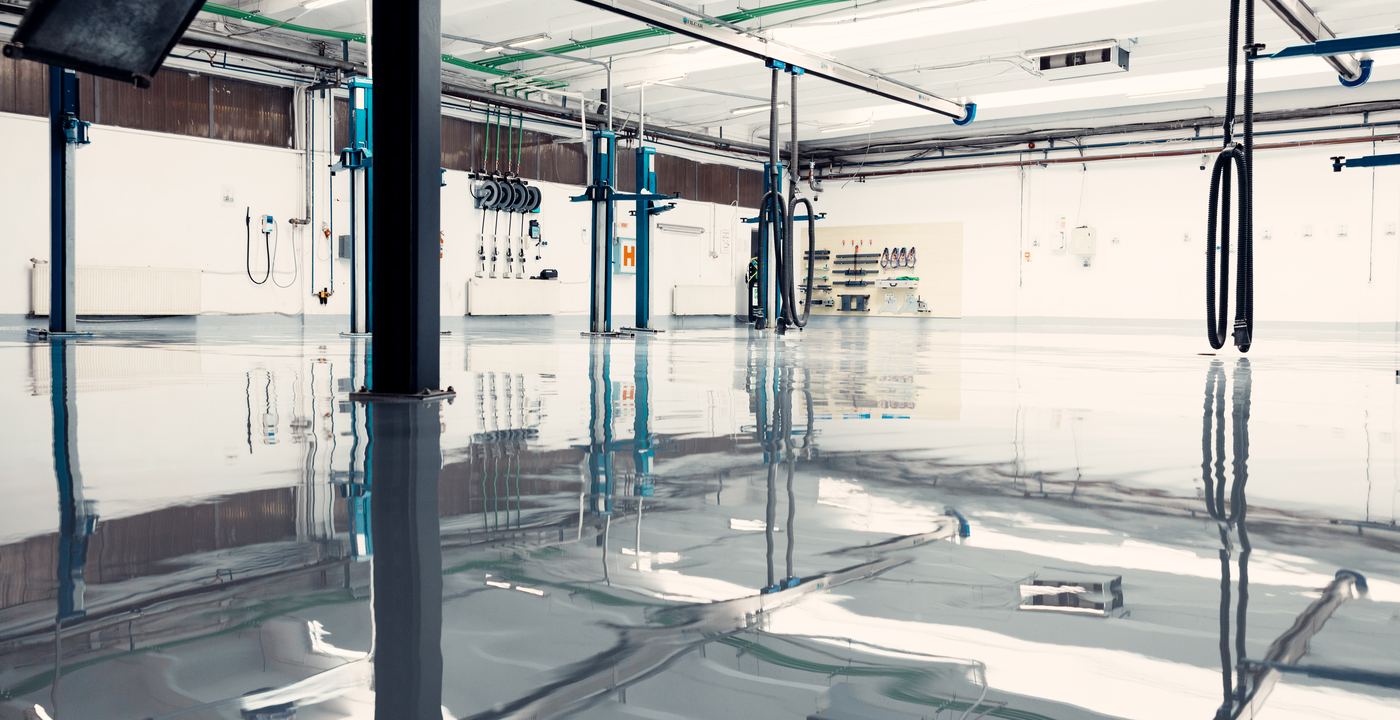
A metallic epoxy floor is a clear, self-leveling epoxy loaded with mica-based metallic pigments. Those pigments are flat, reflective flakes of powder. While the resin is still wet, they drift, settle and stack at slightly different angles, and every angle bounces light differently. The eye reads that as marbling, lava, smoke or pearl, with real depth instead of a printed pattern.
The movement is not a stencil and it is not repeatable. The installer pours, pushes and works the material with squeegees, rollers and sometimes a torch or a light mist of solvent, while temperature, slab porosity and how fast the resin thickens all change how the pigments behave. Two rooms from the same kit, on the same day, will not match. That is the appeal, and it is also the reason to set expectations before the first pour.
It is a decorative system first and a protective one second. The metallic layer carries the look; a clear topcoat carries the wear. Done on a sound, dry, properly profiled slab it makes a seamless, easy-to-clean floor for basements, showrooms, salons and garages. Done on a damp or poorly prepared slab it is one of the more visible floors to fail, which is why this page spends as much time on the slab as on the color.
How the pigments create marbled, lava and pearl effects
Metallic pigment is fine powder made of coated mica and similar reflective particles. Mixed into epoxy, each particle lies flat as the resin levels. Where the resin is thin the particles lie parallel to the floor and reflect strongly, which looks bright and pearly. Where the resin is thick or disturbed the particles tumble at random angles and scatter light, which looks darker and more textured. The contrast between those two states is the pattern.
Color works in layers. A solid base coat sets the background tone, the tinted metallic coat sits on top, and the base shows through wherever the metallic coat is thin. A black base with copper and charcoal pigments reads as molten and dark. A light gray base with pearl and silver reads as soft marble. That is why the base color matters as much as the metallic color you chose from the chart.
Because no machine places the pigment, no two floors repeat. Heat, humidity, the speed of the pour and the way the installer works each section all leave fingerprints. Good installers use that variability on purpose and plan the movement across the room so it flows rather than clusters.
Marbled: soft veining and cloud shapes, the most forgiving look
Lava or river: high contrast, strong flow lines, dramatic in low light
Smoke and cell patterns: created by light solvent mist, producing rings and cells
Pearl and shimmer: low contrast, a floor that changes color as you walk past it
The system layer by layer
Every contractor sequences this a little differently, but a sound metallic floor follows the same logic: bond first, color second, protection last.
Assessment and moisture testing
Before anything is ordered, the slab is checked for age, cracks, prior coatings, spalls and moisture. In-slab relative humidity testing (ASTM F2170) reads moisture at depth inside the slab. The calcium chloride test (ASTM F1869) measures emission from the surface. The acceptable limit is set by the coating manufacturer, not by the contractor. Handheld surface meters are screening tools only. Skipping real testing is a common cause of metallic floor failure.
Diamond grinding
The slab is ground with diamond tooling to remove laitance and old coatings and to open the pores. Thin-film coatings generally call for a profile in roughly the ICRI CSP 1 to 3 range, and diamond grinding produces about CSP 2. The exact profile comes from the coating manufacturer's data sheet. Acid etching is not used.
Crack, joint and spall repair
Cracks are routed and filled, spalls patched, and low areas feathered. Metallic floors show every ridge and patch edge because the finish is so reflective, so repair quality is visible in the final result. Control joints are typically either filled flush or honored and kept as clean lines.
Primer
A penetrating epoxy primer seals the slab and gives the next coats something to grip. On slabs with elevated moisture, a moisture-mitigating primer is used here instead. Many kits call for a contrasting, often black, primer so the metallic coat has depth to show over.
Tinted base coat
A pigmented epoxy in the chosen background color is rolled on and allowed to cure. It hides the gray slab, gives the metallics something to show against, and sets the overall tone of the room.
Metallic coat
Clear epoxy mixed with metallic pigment is poured and spread by squeegee, roller or trowel, then worked while wet. Additional colors are swirled in, mist is applied for cells, and heat or air may be used to guide flow. This is a short, intense window; the installer cannot stop and restart a half-finished section.
Clear topcoat
One or two coats of clear urethane, polyaspartic or additional epoxy lock in the pattern, add gloss and resist abrasion and chemicals. Anti-slip additive is blended in or broadcast lightly at this stage where the space needs it.
Cure and return to service
Light foot traffic is commonly allowed the next day. Furniture, rugs and car traffic wait longer, and the full chemical cure continues for days after that. Cold or very humid conditions slow everything down.
A metallic epoxy system in cross-section
Clear topcoatProtects the metallic coat and sets the sheen; epoxy, urethane and polyaspartic behave differently
Metallic coatPigments worked by hand into marbled, lava or pearl patterns
Tinted base coatThe color the metallic effect floats over
PrimerBonds to the ground slab
Concrete slabDiamond-ground, repaired and moisture-tested first
Illustration, not to scale. Layer names follow the install steps above.
Topcoat options and what each one does
The clear coat is where metallic floors are won or lost over years of use. There are three common choices and none of them is best everywhere.
Epoxy clear coat
Hard, deep and glossy. Standard epoxy is not UV stable and can yellow with sun exposure, which matters little in a windowless basement and a lot next to a sliding door. It generally needs a dry slab and moderate temperatures to cure properly, and cures more slowly than polyaspartic.
Polyurethane (urethane)
Often used as a satin or gloss clear coat over the epoxy to resist scratching. It is a thin film, so the epoxy underneath supplies the depth of the look.
Polyaspartic
A fast-curing, UV-stable clear coat that resists yellowing, so it is often chosen for garages and sunny rooms. It cures much faster than epoxy, which leaves less working time and rewards experienced installers.
Matte or satin finishes
A satin clear coat reduces glare and tends to hide light scratching better than full gloss, while keeping much of the shimmer. Worth asking about for rooms with big windows.
Anti-slip additives
Fine aggregate, such as aluminum oxide or quartz, mixed into or broadcast over the topcoat adds traction without changing the look much. Worth specifying in entries, wet areas and commercial spaces.
Extra clear build
Two topcoats instead of one gives more wear surface to protect the pattern. It also adds labor and cure time, which belongs on the list of cost drivers below.
Prep targets a metallic floor depends on
CSP 1 to 3surface profile range thin-film coatings generally call forICRI Concrete Surface Profile scale
≈ CSP 2what diamond grinding typically producesThe data sheet sets the exact target
2 testsASTM F2170 in the slab and ASTM F1869 at the surfaceMoisture decides the primer
Design choices: color, movement and accents
Most of the visual decision happens before the epoxy is mixed. These are the levers you actually control.
Dark base with warm metallics
Black or charcoal base under copper, bronze and gold. Deep, high-contrast and moody. Dust and lint show more on dark floors.
Light base with cool metallics
Pearl, silver and gray over a pale base. Bright and calm, and more forgiving of daily dust. Pairs well with modern basements and showrooms.
Blue and green palettes
Aqua, navy and teal give a water or marble look. They are the most distinctive color choices and also the most obviously decorative, so pair them with neutral walls.
Heavy versus subtle movement
You can ask for bold flow lines or an even shimmer. More movement is more dramatic and more variable; less movement is calmer and easier to touch up.
Borders, bands and logos
A solid-color or contrasting band along walls, around columns or as a logo inlay frames the floor. Commercial spaces use this for brand colors; homes use it to define a bar or theater zone.
Cove base and accents
Carrying the coating up the wall as a short integral base makes a seamless edge and is easier to clean. Stair treads, steps and landings can match or contrast.
Where metallic epoxy works well
The best candidates are interior spaces on sound, dry slabs where the look is part of the point. A finished basement with a bar and media room, a car showroom, a hair or nail salon, a restaurant dining room, a boutique, an office lobby and a design-led garage all fit.
It is less suited to places where the coating will be hit, dragged or exposed to wet chemicals all day. Those are better served by a thicker, textured system, which we cover in our flake systems or urethane cement pages.
Basements: seamless, easy to clean, and a clear step up from bare concrete, provided moisture is tested first
Showrooms and retail: the reflective finish bounces light and ties into branding
Salons and spas: smooth, wipeable and non-porous when sealed with a good topcoat
Restaurants and bars: strong in dining rooms and entries, with anti-slip additive in service areas
Lobbies and offices: a polished, stone-like look without grout lines
Garages: workable with a UV-stable topcoat and honest expectations about hot-tire pickup and scratches
Gloss is what makes a metallic floor striking, and why prep shows through it.
The slab decides whether this floor lasts
A metallic epoxy floor is a thin, glossy film bonded to concrete. If moisture is pushing up through the slab, the film is the thing that gets pushed. Blisters, cloudy patches and delamination show up fast on a reflective floor, and in the homeowner forums they are the most common horror story. In the research we reviewed for this region, one of the cases was a metallic basement floor on a decades-old Maryland house that began lifting within months, and the installer cut into a bubble and found water.
That is why moisture testing, diamond grinding and a primer matched to the slab are not upsells here; they are the work. A floor that is beautiful on day one and failing in month two is worse than no coating at all. If a contractor skips the test and goes straight to color samples, keep looking.
How ground moisture reaches (and gets trapped under) a coating
Slab with a vapor barrier underneath
Sealed coating
Concrete slab
Vapor barrier
Soil and ground moisture
Less vapor moves up through the concrete, so there is less to push on the coating.
Older slab, no barrier or none you can confirm
Sealed coating
Concrete slab
No barrier, or none you can confirm
Soil and ground moisture
Vapor keeps rising. A thin film cannot hide it: moisture can blister or cloud a glossy metallic coat.
Simplified illustration. A moisture test before coating shows which case a real slab is closer to.
DMV slabs and moisture: what to expect
Across Alexandria, Arlington, Falls Church, Fairfax, Bethesda and DC, plenty of homes are older, and older slabs are more likely to have been poured without a continuous vapor retarder underneath. Building-science sources note that such a barrier cannot practically be added later without removing the slab. That makes older colonials, split-levels and rowhouse basements the ones to test most carefully. A slab can also feel dry in winter and read differently in a humid summer.
Not all summer basement dampness comes up through the slab; humid outdoor air getting indoors is another common source, which is one reason a test beats a guess. Cracks, window wells, sump pumps and poor drainage near the foundation are the usual places to look. A new-construction townhouse is different: the slab may be recent and still drying, which affects when it is ready to coat.
None of this rules out metallic epoxy. It means the slab is tested, the result is read honestly, and the primer is chosen to match. Moisture-mitigating primers exist for some elevated readings, within the limits the manufacturer sets. Above those limits the honest answer may be a different floor, such as a polished concrete finish with no film to blister.
Older slabs: ask for in-slab RH and surface moisture readings, not a guess from touch
Garages: road salt and brine tracked in over the winter should be rinsed off the floor
Townhouse and HOA garages: check association rules on slab work and noise hours
Basements: a simple check is to tape a plastic sheet to the slab for a few days in humid or rainy weather and look for droplets underneath; it is a hint, not a substitute for testing
Metallic epoxy compared with other floors
Every floor wins somewhere. Here is how metallic epoxy stacks up against the common alternatives for the same rooms.
Floor
Look
Seams
Scratch behavior
Moisture tolerance
Repair
Best use
Metallic epoxy
Unique marbled depth, high gloss
None
Shows scratches, especially dark gloss
Film can blister if the slab is wet; primer must be matched
Spot re-coat, pattern rarely matches
Basements, showrooms, salons
Polished concrete
Natural stone-like sheen, variable
Joints only
Hides scratches well
No film to blister
Re-polish
Retail, warehouses, modern homes
Epoxy flake
Speckled, textured
None
Hides scratches and dirt well
Film system, same moisture concern
Easier to blend
Garages, shops
Terrazzo
Classic chips in a matrix
Divider strips
Very durable, hard
Depends on type and install
Specialist repair
Lobbies, institutional
Tile
Many styles, grout lines
Many grout joints
Tile durable, grout stains
Depends on setting bed; grout absorbs
Replace individual tiles
Baths, kitchens, entries
LVP
Printed wood or stone look
Many plank seams
Dents and gouges
Varies by product; water-resistant does not mean vapor-proof
Replace planks
Basements, living areas
General comparison only. Actual performance depends on the product, the slab and how the floor is used. We install the metallic, polished concrete and flake systems; we do not install terrazzo, tile or LVP.
Honest limits of metallic epoxy
No coating is right for everything, and metallic epoxy has real tradeoffs. Knowing them up front is the difference between a floor you love and one you resent.
The most important point is slab condition. A thin film cannot hide a moisture problem or a badly prepared surface. The second is that the finish is smooth by nature. The third is that a hand-worked floor is never an exact match to a sample photo.
Needs very good prep: every grinder mark, patch edge and ridge can telegraph through a glossy surface
Moisture sensitivity: vapor pressure can blister or cloud the coating
UV yellowing: standard epoxy is not UV stable and can yellow in direct sun; a UV-stable polyaspartic topcoat reduces this
Scratch visibility: dark and glossy floors show scratches and dust more than light or textured ones
Slipperiness: glossy floors are slick when wet, so entries and wet zones need anti-slip additive
Repairs are visible: because the pattern is hand-made, a patch rarely disappears; repair is usually a blended re-coat of a whole section
Hot-tire pickup in garages: ask how the chosen topcoat handles hot tires
Variation by hand: that is the charm, but it is not controllable to a photo
Metallic epoxy: a good fit or a bad fit?
A good fit when
The room is a showpiece: basement, showroom, salon, lobby
You want a seamless floor with no two alike
The slab tests dry or within the primer limits
A UV-stable clear is specified where sun reaches the floor
Anti-slip texture is planned at entries and wet zones
Think twice when
The slab has a moisture problem that primers cannot cover
The floor sits in direct sun with a plain epoxy clear
You need scratches and dust to disappear on a dark gloss
Hot tires will park on it without a rated topcoat
You expect a repair to match the original pattern exactly
Drawn from the limits section above.
Cure and use timelines (general ranges)
These are typical ranges for epoxy-based metallic systems, not promises for any particular job. Temperature, humidity and product choice move them.
Milestone
Typical range
What affects it
Grind, repair and prime
About 1 day
Slab size, cracks, prior coatings
Working temperature
Many kits specify roughly 50 to 90 F
Check the data sheet; cold slows cure
Base coat to metallic coat
Several hours to overnight
Temperature and humidity
Recoat window
One kit lists 12 to 24 hours
Product and conditions
Light foot traffic
Commonly the next day after the final coat
Topcoat chemistry
Furniture and rugs
Several days
Wait for the film to harden fully
Vehicles in a garage
One kit lists about 72 hours; epoxy topcoats can take longer, polyaspartic less
Topcoat type and temperature
Full cure
Several days up to about a week
Cold slows it down
Always follow the manufacturer data sheet for the specific system installed.
When a metallic floor can be used (general ranges)
0h24h48h72h96h120h144h168h
Recoat window
12 to 24 h (one kit)
Light foot traffic
commonly the next day
Vehicles in a garage
about 72 h (one kit)
Full cure
several days to about a week
Typical ranges from the table above, not promises for a specific job. Always follow the data sheet for the installed system.
Care and maintenance
Metallic floors are easy to live with. A soft dust mop or microfiber pad picks up grit, which is what actually scratches the surface. A damp mop with a neutral pH cleaner handles everything else.
Avoid harsh solvents, bleach-heavy cleaners and abrasive pads. Put felt pads on furniture and lift, do not drag, heavy items. In a garage, wipe road salt and brine off in winter, since it dulls and stains thin topcoats over time.
On busy floors, a fresh clear coat after some years restores gloss and adds wear protection without touching the pattern underneath. That is far cheaper than redoing the whole system, and a reason to choose a repairable topcoat from the start.
Sweep or dust mop often; grit is the real enemy
Mop with a neutral cleaner and clean water
Use mats at doors to catch sand, salt and moisture
Pad furniture and avoid rolling hard-wheeled casters
Wipe up spills of oil, wine and chemicals promptly
What affects the cost of a metallic epoxy floor
Metallic systems are priced per project, not from a single number, because the work varies so much from floor to floor. We quote after a free on-site assessment. These are the factors that drive the total.
Square footage and the shape of the space
Slab condition: cracks, spalls, old coatings, and areas needing grinding to remove prior material
Moisture results and whether a mitigating primer is required
Number of colors and how much movement and detail you want
Number of topcoats and the topcoat chemistry
Anti-slip additive, borders, logos and cove base
Stairs, columns, finished walls and tight access
Working around schedules, such as phased commercial installs
What to ask a contractor before you sign
Metallic floors reward installers with experience and punish those without it. These questions separate the two quickly.
Will you test slab moisture, and which test method will you use?
How will you prepare the surface, and will you diamond grind?
What primer will you use on my slab, and why?
Can I see photos of metallic floors in rooms like mine?
Which topcoat will you use, and how does it handle sun and scratches?
How will you treat cracks and joints, and will they show?
Will you add anti-slip, and where?
What happens if a problem appears after install, and who comes back?
Questions
Metallic epoxy floor questions we hear most
What is a metallic epoxy floor?
It is an epoxy coating mixed with metallic pigments that settle into marbled, swirled or pearl-like patterns while the resin cures. It sits over a primer and a tinted base coat and is sealed with a clear topcoat. The result is a seamless floor with a three-dimensional look.
Why is every metallic floor different?
The pigments move as the epoxy flows, and the installer works them by hand. Temperature, humidity, slab porosity and pour speed all change the result. That means no two floors match, even from the same kit.
Is metallic epoxy a good choice for a garage floor?
It can be, with the right topcoat and expectations. A UV-stable polyaspartic clear coat helps with sun yellowing. It will show scratches more than a flake system, so if the garage is a working shop, consider flake instead.
Will it look exactly like the sample or photos?
No. Samples show color and style, not your exact floor. A good contractor will show past installs, agree on colors, and can mock up a small area, but the final pattern is hand-made.
Will metallic epoxy yellow?
Standard epoxy is not UV stable and can yellow in strong, direct sunlight over time. A UV-stable polyaspartic topcoat reduces that risk. In a windowless basement it is rarely a concern.
Is it slippery?
Gloss floors are slick when wet. We recommend a fine anti-slip additive in entries, wet areas and commercial spaces, since it keeps the look while adding traction.
Can it go in a basement that feels damp?
Sometimes, but only after testing. We measure in-slab relative humidity and surface moisture vapor emission. Some elevated readings can be handled with a moisture-mitigating primer within the manufacturer's limits. Readings beyond that may mean a different floor is the honest recommendation.
How long does installation take?
Often a few days on site: grind and repair, prime, base coat, metallic coat and topcoat, with cure time between layers. Larger or more detailed floors take longer. Ranges depend on conditions, not a fixed schedule.
How soon can I walk on it and move furniture back?
Light foot traffic is commonly fine the next day. Furniture, rugs and vehicles usually wait several days while the film hardens. Follow the data sheet for the specific system used.
Can scratches or damage be repaired?
Minor scuffs can often be buffed or re-coated with clear. Deep gouges are harder because the pattern is hand-made and rarely matches. Repairs are usually blended across a section rather than spot-patched.
How do I clean and maintain it?
Dust mop often and damp mop with a neutral pH cleaner. Use mats at doors, pad furniture, avoid harsh solvents and wipe road salt off in winter. A fresh clear coat after some years renews high-traffic floors.
How is it different from polished concrete or flake?
Polished concrete is the slab itself, hides scratches well and tolerates moisture better. Flake is textured and very forgiving. Metallic is the most decorative and less forgiving of moisture and scratches. See polished concrete and flake systems.